Lessons from Little Women
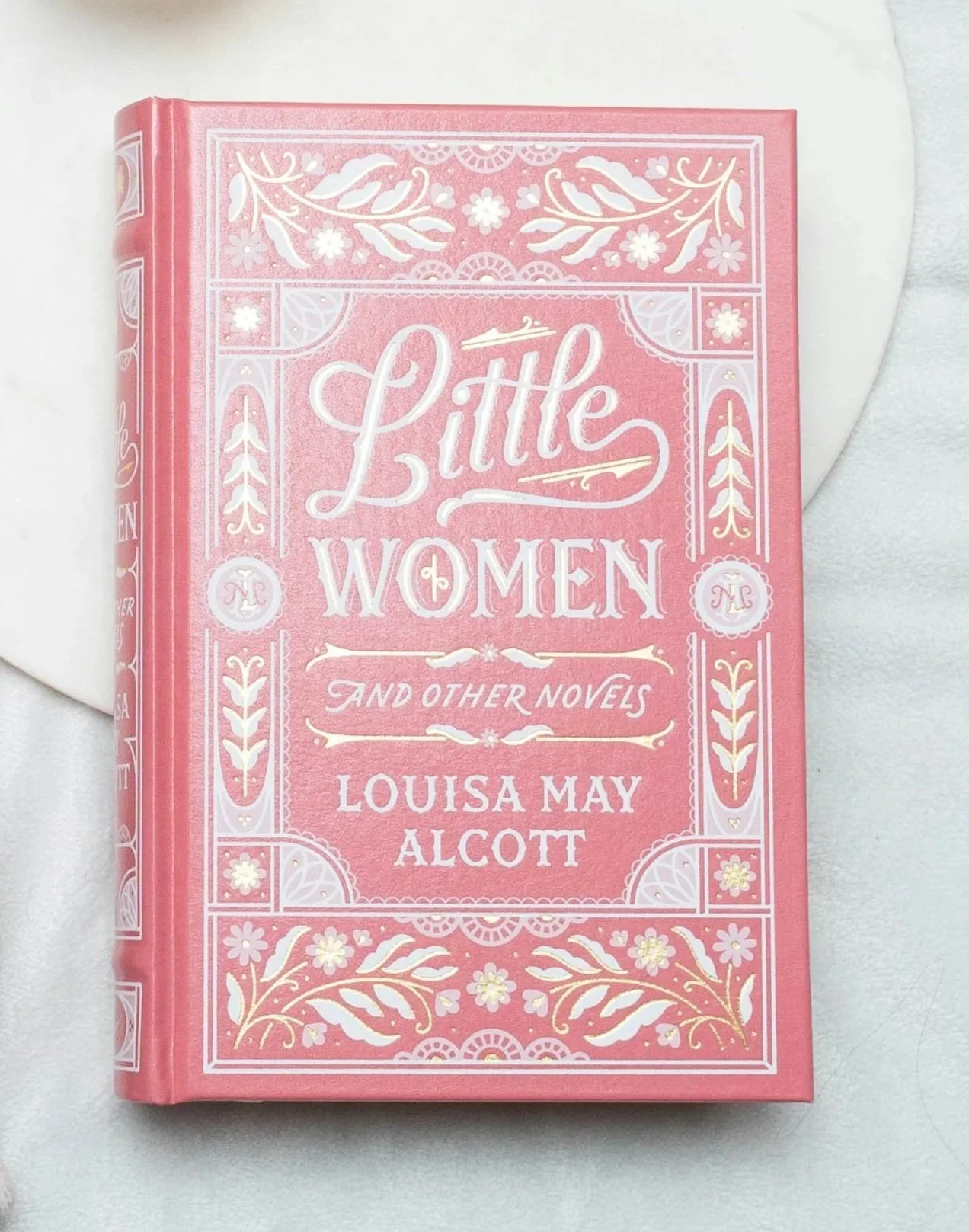
This year I told myself I would read the classics, especially ones written by women, because I felt there was a lot to learn from them. I’d read Frankenstein last fall and loved Mary Shelley all the more. After getting a little distracted by modern stories — why are there so many great adaptations happening this year?! — I finally turned to others I’d been gifted. I first read one of Agatha Christie’s Poirot stories, and I just recently faced the pen of Louisa May Alcott.
Little Women is a movie I’ve seen but a book I’d never read, and now that I have done, I am struck with a mix of despair and hope. I love the adaptations, of course, and they’re powerful in their own right, but to actually examine the text for yourself is another story altogether. The book is preachy as a Sunday sermon, each chapter being a short story with a moral at the end. Once you get past that, it’s full of lovely lessons, though maybe not the ones Louisa May wanted us to learn. I find I am changed.
The book opens with our four young heroines putting on a play, dressing up, and writing stories for their own makeshift newspaper, in which they take male aliases (because even in their imaginations, that was the only way they could freely express themselves). The society around them is one torn by the Civil War, and they are learning to make due without the head of their family. Each of them are teenagers, or almost, and are childlike in their own way.
The first time they hang out with their new neighbor, dear Teddy Laurie, it’s a sunny day on a hilltop near their houses. Reading poetry and collecting pinecones and laughing along the way, they glance at the sky where fluffy white clouds are billowing by. What castles would you build there, if you could? Each of them has their own temple growing in their imagination of what they want their lives to be. They weave wonderful futures in their mind’s eye, full of creativity and beauty and love.
A child’s perspective, perhaps, but they are dreaming, as we all do, of who we might become. I think it’s important to hold on to that mindset.
At the end of the book, this castle-building chapter is mirrored in one called “Harvest,” where we accept the fact that the lives they wanted to build did not come to be, but they are each happy anyway. It’s a lovely button on the scene, from an artistic standpoint. But from the standpoint of a woman, all I can see is the lack of options these women had in life. Each of them stayed home, married, and birthed several children. The castles then were only clouds, and each became what was expected of them.
I had to remind myself often: this book was published in 1868.
I identified a little bit with each of the women as they grew up, but I found I understood Amy the most in the end. She made mistakes as a child that, when watching the movies, tends to paint her character forever in a negative light, but the book shows otherwise. She became as graceful and poised and kind as any young lady, who knew what she wanted and went after it. She was quick to turn the other cheek and love her neighbors and friends. I really admired her.
The connection she built with Laurie was one I never understood while watching the movies, but appreciate all the more after reading the book. Laurie says, “It takes two flints to light a fire, and you are cool and calm as snow.” It reminded me greatly of Katniss Everdeen in The Hunger Games, who realized that she didn’t need Gale’s fire to match her own, but Peeta, the soft dandelion in the spring, the boy who gave her bread when she needed it. Maybe that’s what marriage needs, two tempers coming together so they can find balance.
Amy and Laurie join in the rest of the Marches and become the big, happy family they always dreamed. They are also rather philanthropic with Laurie’s extensive wealth, which I appreciate (rich people are often painted negatively in the book, and poverty romanticized). My biggest qualm of their characters is that they each gave up on their creative pursuits.
Amy said, “Talent isn’t genius, and you cannot make it so,” after going to Rome and seeing all the brilliant Renaissance-era art on display there. She said, “I want to be great or I want to be nothing.” So she gave art up up, just a silly hobby on the side, to focus on family and society instead. Laurie tried his hand at composing music, but soon agreed with Amy. He’d never be “great,” so he needed to settle and do some proper business. A story I’ve heard repeated over and over, even today.
While Amy and Laurie spent their time well, helping their community, loving each other and their family and the world, a part of my soul was wounded by this mindset. This whole blog is dedicated to creativity, and how important it is to hold on to — and yet, they swiftly and easily let it go just because they aren’t “good enough.”
Haven’t they read my Doodling Directives? Your art doesn’t have to be “good,” it just has to be yours!
Oh, if only they let themselves create as they are! If they moved as freely as Jo, who began writing from the heart instead of for the desire of fame or money, and she found success! It reminded me that we each might yet become the greatness we seek. All it takes is time, and drive, and dedication, and love. Don’t give up.
The next thing of note for me in my read is one I can’t believe I never knew before: Jo March is a trans man, through and through.

It’s clear she longs to be a man, and it’s a thought she repeats often. Laurie even calls her “fellow,” because masculinity comes more naturally to her than anything. This was never touched on in any film I’ve seen, or play. Someone recently told me Louisa May Alcott often went by “Lou,” and used he'/him pronouns around his family, but went by that famous feminine name in public. This makes the story all the more devastating, in my opinion, knowing what was required of AFAB people back then. And we see it in Jo.
I think this is why Jo could never truly be with Laurie, whom she obviously loved. Who else would understand? I do believe the proposal forced Jo to confront the fact that childhood was over, and she couldn’t be Laurie’s playmate forever. She had to don the costume of “woman,” one that she already struggles to wear every day, and at such a young age, she couldn’t accept it. Eventually she does; she folds herself into domesticity, care of Beth and her family and the home, and falls in love. Sometimes the fire of youth is tempered with grief, and after Beth passed, she learned to be what was expected of her. That’s why she was able to love the Professor, and why she went on to have a family of her own.
Did she ever write again?
I believe Jo spent the rest of her days chasing that freedom of a boyish youth by opening her school. She came to care for the Lost Boys at Plumfield like Wendy in Peter Pan, even though it meant neglecting her own truth. Wendy, however, even when everything was pretend, still had to be Mother. And that is what I can’t get over: how even I, in 2026, fall into the trap of expectation, the people pleasing, the care-giving, the loss of self in the name of social demand. Jo lost me in the middle and found me at the end, a mirror I can’t help but face, Aunt Dodo to her sister’s twins, and a lost lamb trying to find a place she belongs.
In 2026 eyes, that’s a hard read. Even though I don’t think I am a man, I do feel a bit more fluid than the prescribed gender roles assigned to women today, and fall somewhere in the middle. I can’t help but think how lucky we are to have the freedom to be who we wish. So what if there’s an active campaign to squash our rights? They’ll never shove us back into something we’ve long since outgrown. It’s easy to see how far we have come after reading this book; now that their 19th century social customs are gone, their fashions seem all the more odd to modern eyes. It’s also hard to see that we have even farther to go on our way to the next horizon. But we’re closer than we’ve ever been, and I am grateful. What a time to be alive.
Jo is both an inspiration and a cautionary tale, and Meg is more the latter, in my eyes. She readily and gladly accepted the roles of wife and mother. All of her creativity went into the household, the children, and her husband, and it’s clear to me she was lost. She took her mother’s advice often, to become exactly what a woman was expected to be in that world. But she disappeared. Chapters passed without mention of Meg. We rarely ever heard her thoughts and wishes after she got engaged to Brooke. This was the saddest story of all, to me.
But what other choice did she have? Meg was 17 when she got engaged to John Brooke, 28. She was a child! What could she possibly know of the world? The idea of it makes me sick.
Perhaps a little insensitively, but speaking of sickness, the last of the ladies is the one that we lost. That sweet angel, that Beth March! What a devastating blow it was, knowing she accepted her death and “tried to be willing” to face it with dignity, which we all must someday do. The hardest part of all was that Beth thought herself to be stupid, childish, and worthless. It shows the amount of self-love that was a priority for these women, because they praised her for the love she continually gave, the work she did at home, the light she was to others. It was a virtue to never think of yourself, but only as a woman. And she was so young when she passed, only 18 years old. A moment that stuck out to me was when Beth read one of Jo’s poems about her, about how the demeanor Beth lived by was one Jo would emulate after she was gone. Beth said she was happy to go knowing she didn’t waste her life, if she helped one person be better.
She was a brilliant musician, though, and loved by her family and neighbors for her kindness and her gifts. Mr. Laurence gifted her a piano, and Laurie thought she was a genius with music. What a compliment, considering he wanted to be a composer himself. Beth didn’t see it that way. Her castle in the sky was heaven. She repeated often that she never had any dreams for her future beyond puttering about at home, playing with dolls, and one day, all too soon, it was over. The family “gave her back to God.”
You may think you’re unimportant, but your story matters. Build yourself a library of your thoughts, your art, your life because… well, why not?

Stories are a magic all their own, and to learn from them is a gift!
Life is short, and while we have a chance, we must take hold of it, love it, make our art, enjoy our fellows’ company. We have to hold on to that castle we imagine in the sky. Because we can create it ourselves, especially now, when we have all the freedom in the world to make it happen. Especially as women. Especially as queer and trans people. Look at the beautiful world we fought to create! Even though it’s rather dark right now, we can and will reclaim that future together. I believe it.
Ultimately, I began to see an important lesson for myself in the end, too. Life can be our art as much as the crafts we pursue. It’s important to be present, and humble, and to accept where you are while you work toward what you have. Life will inform your art and your art can inform your life.
I hope to be like each of the women in turn, in some way. I want to write like Jo, but I wish to accept myself fully and be who I really am. I am an artist like Amy, who wants to be great, but I refuse to be nothing. I will continue to pursue it, even if it’s just for me. I want to be kind like Beth, but love myself enough to know that I am valuable on my own. And when it comes to Meg, I hope that if I ever find myself following the same path, that I will hold on to myself, my art, and my independence all the way through. I guess I hope to be like Marmee, their beautiful mother, too, who is full of patience and wisdom and love in her own right.
Now that I’ve read the text, I hope to re-watch the adaptations with a fresh eye, and learn what I can from them. Perhaps if I, like Jo March, like Louisa May Alcott, write my own book, it will live on as Little Women has done. It’s been almost a hundred and sixty years since its publication and it still shines its lovely light! Generations of women see themselves painted here, and it’s really withstood the test of time. I suppose that’s why it’s a classic, and why we should read them still today. Yes, the world has changed, but you’ll be changed, too. It’s important to be where you are, but it’s also important to remember where we’ve been — even if we can’t go backwards. Stories will take us forward, and we can shape our world through the magic in our heARTs.
Just hold on to your creativity and remember it. Go forth and create, Little Women (and genders otherwise), and know I’m right there with you.